
Speech, Language and Early Literacy
22 July 2026 · Hunter Children's Clinics
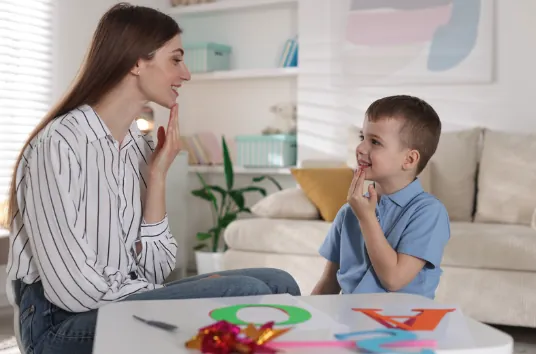
Reading is often thought of as a visual skill, learning to recognise letters and words on a page, but spoken language plays just as large a part. Children draw on the vocabulary, sentence structure and understanding they have already built through talking and listening when they learn to read and spell. This article looks at that connection, and at when reading or spelling difficulties might be worth a closer look.
How spoken language supports reading
A helpful way to think about reading is as two skills working together: decoding, which is sounding out and recognising written words, and language comprehension, which is understanding what those words mean once they are read. Both matter, and both need to be reasonably strong for a child to read with understanding. A child can be a capable, accurate decoder and still struggle to comprehend what they have read if their spoken language skills are not yet strong enough to support it, and the reverse can also be true. This is part of why speech pathologists, whose core focus is spoken language, have a natural role to play in supporting early literacy.
Language skills evident in the preschool years, such as vocabulary and understanding of sentence structure, are linked to reading outcomes well into the school years. Skills like phonemic awareness, hearing and playing with the individual sounds in words, and alphabet knowledge tend to matter most for early decoding, while broader language comprehension becomes increasingly important for understanding what has been read as children move through school.
Developmental Language Disorder and reading
Developmental Language Disorder, often shortened to DLD, describes ongoing difficulty understanding or using spoken language that is not explained by another condition such as hearing loss or a diagnosed intellectual disability, and is significant enough to affect everyday life at home, school or with friends. It is thought to affect somewhere around 1 in 14 children, making it considerably more common than many families realise, roughly two children in an average classroom. Because spoken language is so closely tied to reading, children with DLD are at meaningfully higher risk of also finding reading and spelling difficult, although DLD and reading difficulties are related rather than the same thing, and a child can have one without the other.
When reading or spelling difficulties may need a closer look
Before school, early signs can include difficulty learning nursery rhymes, playing with the sounds in words, or learning the alphabet. In the early years of primary school, it may be worth a conversation with your child's teacher, GP or a speech pathologist if your child reads slowly or without expression, tends to guess at words rather than sound them out, avoids reading aloud, or struggles to explain what they have just read. In later primary and high school, ongoing difficulty with reading fluency, patchy comprehension, or a more limited vocabulary than classmates can also be worth raising. A family history of reading difficulty or dyslexia is itself a reasonable prompt to keep an eye on how things are progressing.
Dyslexia and how it relates to language
Dyslexia is a specific and persistent difficulty with accurate or fluent word reading and spelling, typically linked to how the brain processes the sound structure of language, and separate from a child's general intelligence or the quality of their teaching. Dyslexia and DLD are related conditions that share some of the same underlying language-processing skills, and research suggests a meaningful proportion of children with one also meet criteria for the other, though estimates vary a good deal depending on how each group was identified. In practice, this means a family raising concerns about reading is sometimes also describing a broader pattern of spoken language difficulty, and vice versa, which is exactly why looking at both together can be worthwhile.
Everyday ways to build spoken language at home
Much of the language a child brings to reading is built through everyday talking, well before formal reading instruction starts. Reading books together, talking about the pictures and what might happen next, singing songs and nursery rhymes, and simply having back-and-forth conversations over the day all give children practice with vocabulary, sentence structure and the sounds within words. None of this needs to be formal or structured to be valuable, and it is worth continuing alongside any professional support, not instead of it.
Why speech pathology and psychology may both be involved
In Australia, a formal diagnosis of dyslexia typically involves psychoeducational or cognitive assessment, usually carried out by a psychologist. Our speech pathology service, provided by Claire Cooper, supports the spoken-language and phonological skills that sit underneath reading and spelling, which is often the first piece of the picture families notice and a valuable contribution to understanding a child's overall profile. Where a specific learning difficulty such as dyslexia may be involved, our speech pathologists work alongside our psychology assessment team, so that both the language and the cognitive side of the picture are considered together. You can read more about supporting your child through a psychology assessment, and see current fees for both services on our fees and referrals page.
Related reading: signs your child may need speech therapy, stuttering in children, and what to expect from a parent-only intake session.
This article is general information only and is not a substitute for individual medical advice. If you have concerns about your child's speech, language, reading or spelling, please speak with your GP, paediatrician, or your child's teacher.